At the end of November, twelve representatives of municipalities, NGOs, and regional administration from the Kirovohrad region of Ukraine completed a six-day study trip through Poland, Czechia, Slovakia, and Hungary. They came with questions. They returned with answers — and with the beginnings of concrete plans for their communities.
The journey
The trip began in Warsaw on 24 November, where participants were welcomed by Aleksander Arabadžić of the Academy of Polish Careers and spent a full day with experts from Warsaw University of Technology, water monitoring technology company Water Sense, and Poland's national water authority PGW Wody Polskie. The topics ranged from blue-green urban infrastructure and innovative water quality monitoring to EU investment financing mechanisms and drought risk planning tools — all interpreted consecutively into Ukrainian.
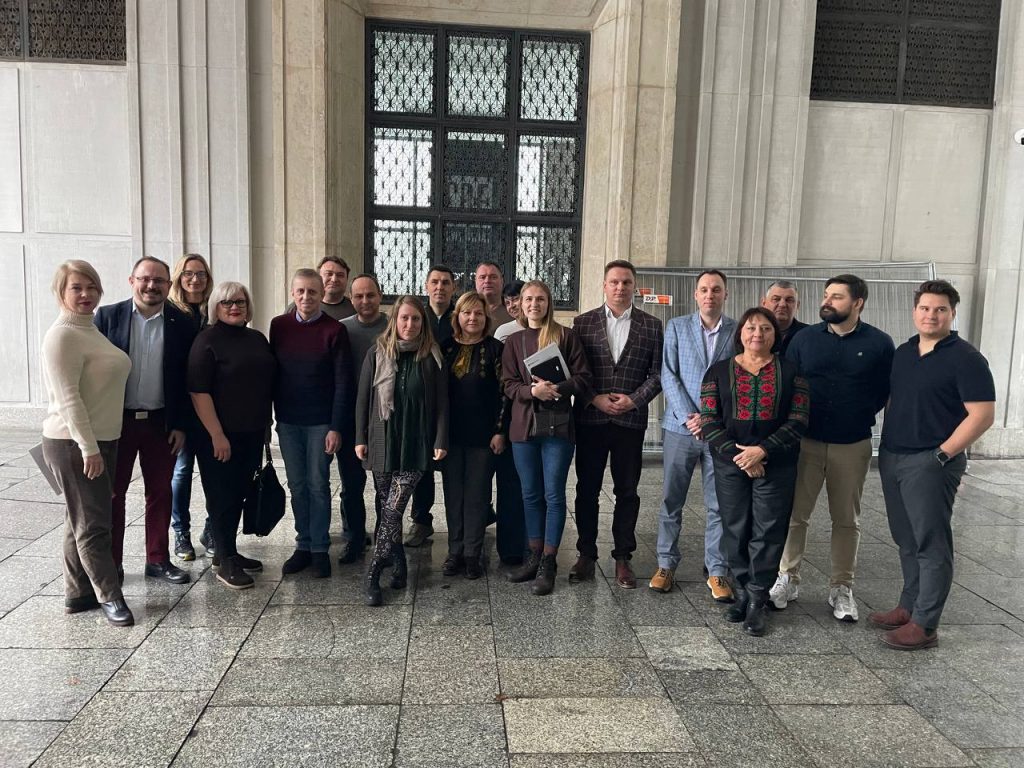
From Warsaw, the group travelled by minibus into Czechia. In Ostrava, they met with specialists from the Czech Hydrometeorological Institute and the director of the Odra River Basin authority, Petr Birklen. The afternoon took them to the town of Krnov — population 19,000 — where managing director Libor Staněk and municipal services head Pavel Jachymčák guided them through a wastewater treatment plant that produces most of its own energy through biogas. For participants whose communities struggle with power cuts caused by Russian attacks on energy infrastructure, this was one of the trip's most striking moments.
"In Krnov we saw that energy dependence of water infrastructure is a solvable problem," noted one of the participating mayors. "That changes how we think about what is possible."
The group then moved to Brno, visiting the Open Garden — a model of sustainable urban water management — and the Yellow Hill reservoir. The following morning, ecologist and landscape expert Mojmír Vlašín led the group through the village of Ořechov and the Soutok nature reserve, demonstrating how nature-based water retention measures work at a landscape scale.
In Slovakia, the programme shifted to decentralised solutions. Expert Adam Krakovský of ECOPLANET SLOVAKIA showed participants two operational wastewater treatment systems — one serving a historic museum building, another a glamping resort — demonstrating that effective treatment is achievable even for facilities far from central sewage networks. The Technical University in Zvolen presented water retention measures on its own campus, and Martina Paulíková of Združenie Slatinka walked the group through the village of Slatinka itself — a community that successfully resisted being flooded by a planned dam, and whose story resonated strongly with participants fighting to protect their own local environments.
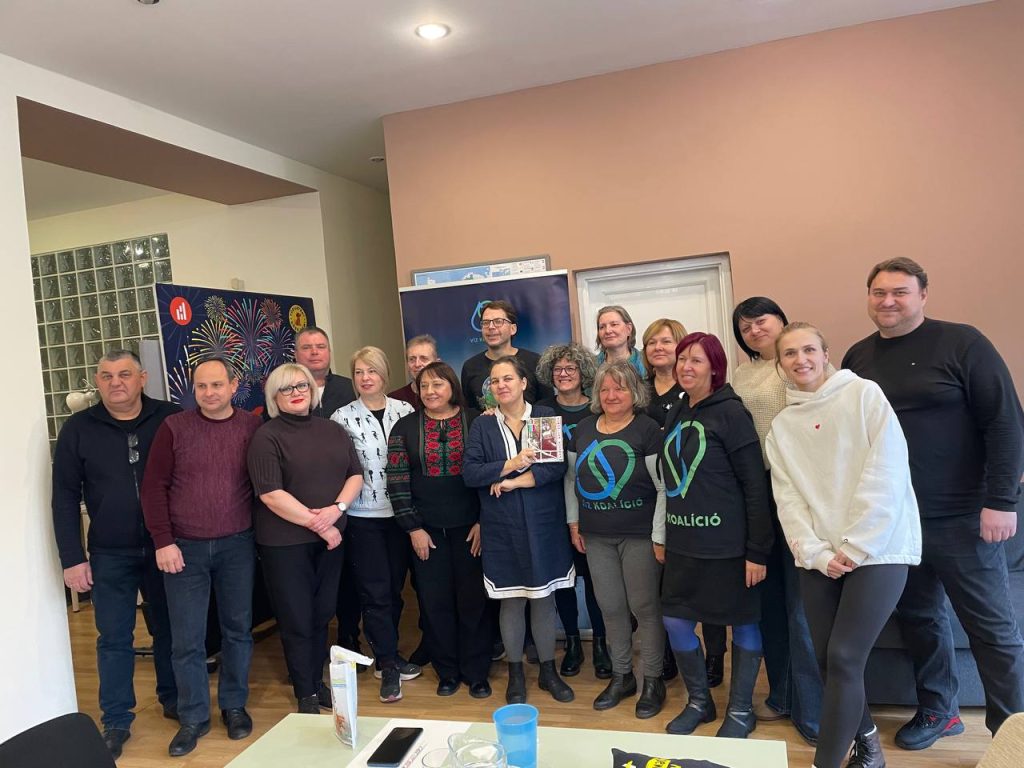
The final day brought the group to Budapest, where the Civil College Foundation hosted a structured exchange with members of the Water Coalition — a network of over thirty NGOs and municipalities — and representatives of several communities from the Pest region. It was a fitting conclusion: a conversation between people who have spent years building cooperative solutions to water challenges, and people who are just beginning that journey.
What they brought back
The study trip was never intended to be a sightseeing exercise. Within weeks of returning home, participants had begun converting what they saw into action. Two concrete plans are already being in development.
And the follow-up has not stopped there. NESEHNUTÍ Brno, through its Sun for Ukraine initiative, is considering installation of a solar power plant on the Bobrynets water infrastructure — ensuring the system can keep running even when the power grid goes down. Meanwhile, the municipalities and organisations involved in the project are now preparing a joint project, which would move from planning to actual infrastructure implementation.
Why it matters
Water is not an abstract environmental issue in the Kirovohrad region. It is a daily, practical, sometimes desperate concern — for mayors trying to keep taps running, for communities whose rivers are silting up and drying out, for people drinking water they know is not safe because there is no alternative.
This project did not solve those problems. But it connected people who face them with people who have begun to solve similar ones — and gave them the knowledge, the contacts, and the confidence to start moving. That, in the end, is what knowledge exchange is for.
The Visegrad–Ukraine Water Solutions Exchange is supported by the Visegrad Fund. Project partners include NGO FLORA (Ukraine), Academy of Polish Careers (Poland), Združenie Slatinka (Slovakia), and Civil College Foundation (Hungary).

The exchange was also supported by the Ministry of Foreign Affairs of the Czech Republic under the Transition Promotion Programme.
Ministry of Foreign Affairs of the Czech Republic, TRANSITION programme