When twelve representatives of municipalities and civil society organisations from Ukraine's Kirovohrad region returned home from their study trip through the Visegrad countries last November, the real work was just beginning. Two months later, the results are in — and they go further than anyone had planned.
Two plans, two communities, one shared ambition
The first concrete output comes from the Adzhamka hromada, a small rural community whose river — the Adzhamka — has been slowly dying. Silting, eutrophication, falling groundwater levels, and the degradation of land have turned what was once a functioning waterway into a system of shallow, stagnant pools. Agricultural encroachment on protected riparian zones has accelerated the damage, and the community has lacked both the legal documentation and the institutional tools to stop it.
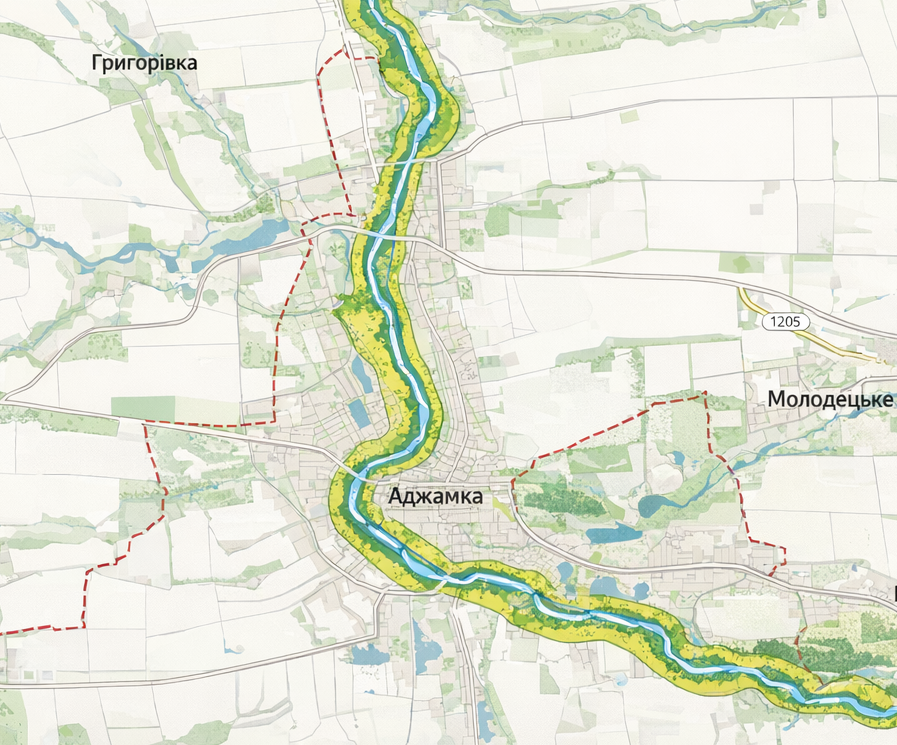
Working with NGO Eco Liga Centre, the Adzhamka hromada has now developed a comprehensive six-step river revitalisation plan. It covers the establishment of legally binding riparian protection zones with physical boundary markers, a full inventory of land use violations along the river, the removal of ploughed land from protected strips and their restoration through reseeding with perennial grasses and riverside vegetation, the survey and restoration of springs and natural water sources, the removal of unused pond dams that block natural flow, and the recovery of the river's self-purification capacity through nature-based solutions including constructed wetlands and phytofilters. The plan is accompanied by a detailed analytical background document and a full technical specification for the land planning documentation required — making it ready to serve as the basis for a funding application.
The second plan addresses a more immediately critical situation. The Polumjanske reservoir on the Sugoklia river is the sole centralised drinking water source for the town of Bobrynets and surrounding settlements — more than ten thousand people. Built in 1988, the reservoir has not undergone major repair in over thirty years. The spillway is partially destroyed. Water losses are constant and uncontrolled. The reservoir's capacity has dropped from 2.5 million cubic metres to 1.5 million — and in dry periods, the risk of complete depletion is real.
The project proposal developed by NGO Eco Liga Centre, in partnership with Bobrynets municipality, the Regional Water Resources Office in Kirovohrad Oblast, and the Southern Buh Basin Council, outlines a phased reconstruction programme: comprehensive hydrological and ecological assessment, repair of the dam spillway using modern composite materials, bank reinforcement, installation of an automated water level and quality monitoring system, and the development of long-term water management recommendations for the community. The plan is fully aligned with the EU Water Framework Directive and the Southern Buh River Basin Management Plan for 2025–2030, and is designed to restore the reservoir's full capacity for at least twenty years.
And then came the solar panels
While the action plans were being finalised, NESEHNUTÍ Brno took a step that was not part of the original project — but felt like a natural consequence of everything that had been learned.
One of the most powerful moments of the study trip had been the visit to the wastewater treatment plant in Krnov, Czech Republic, where participants discovered that the facility generates most of its own energy from biogas and is therefore largely independent of the external power grid. For Ukrainian participants whose communities face regular blackouts caused by Russian attacks on energy infrastructure, this was not an abstract lesson in sustainability — it was a direct answer to one of their most pressing daily problems.
The Bobrynets water infrastructure, like that of many Ukrainian communities, depends entirely on grid electricity to pump and distribute drinking water. When the power goes down, the water stops. NESEHNUTÍ's Sun for Ukraine initiative — which collects decommissioned solar panels from Czech solar plants and donates them to Ukrainian municipalities — responded directly to this vulnerability. 605 solar panels have now been provided for installation on the Bobrynets water infrastructure, ensuring that the system can continue operating even during prolonged blackouts.
What comes next
The two action plans are not the end of the road — they are the beginning of a longer process. The municipalities and organisations involved in the Visegrad project are currently preparing a joint project which would move beyond planning and into actual infrastructure implementation. Both plans developed within this project are positioned as ready-made components of that larger submission.
The path from a study trip through four countries to solar panels on a Ukrainian water pump station was not a straight one. But it was a logical one — and it is exactly the kind of path that knowledge exchange, when done well, is designed to open.
The Visegrad–Ukraine Water Solutions Exchange is supported by the Visegrad Fund. Project partners include NGO FLORA (Ukraine), Academy of Polish Careers (Poland), Združenie Slatinka (Slovakia), and Civil College Foundation (Hungary).

The exchange was also supported by the Ministry of Foreign Affairs of the Czech Republic under the Transition Promotion Programme.
Ministry of Foreign Affairs of the Czech Republic, TRANSITION programme